
The Bible Beneath the Binary
A relational reading of scripture

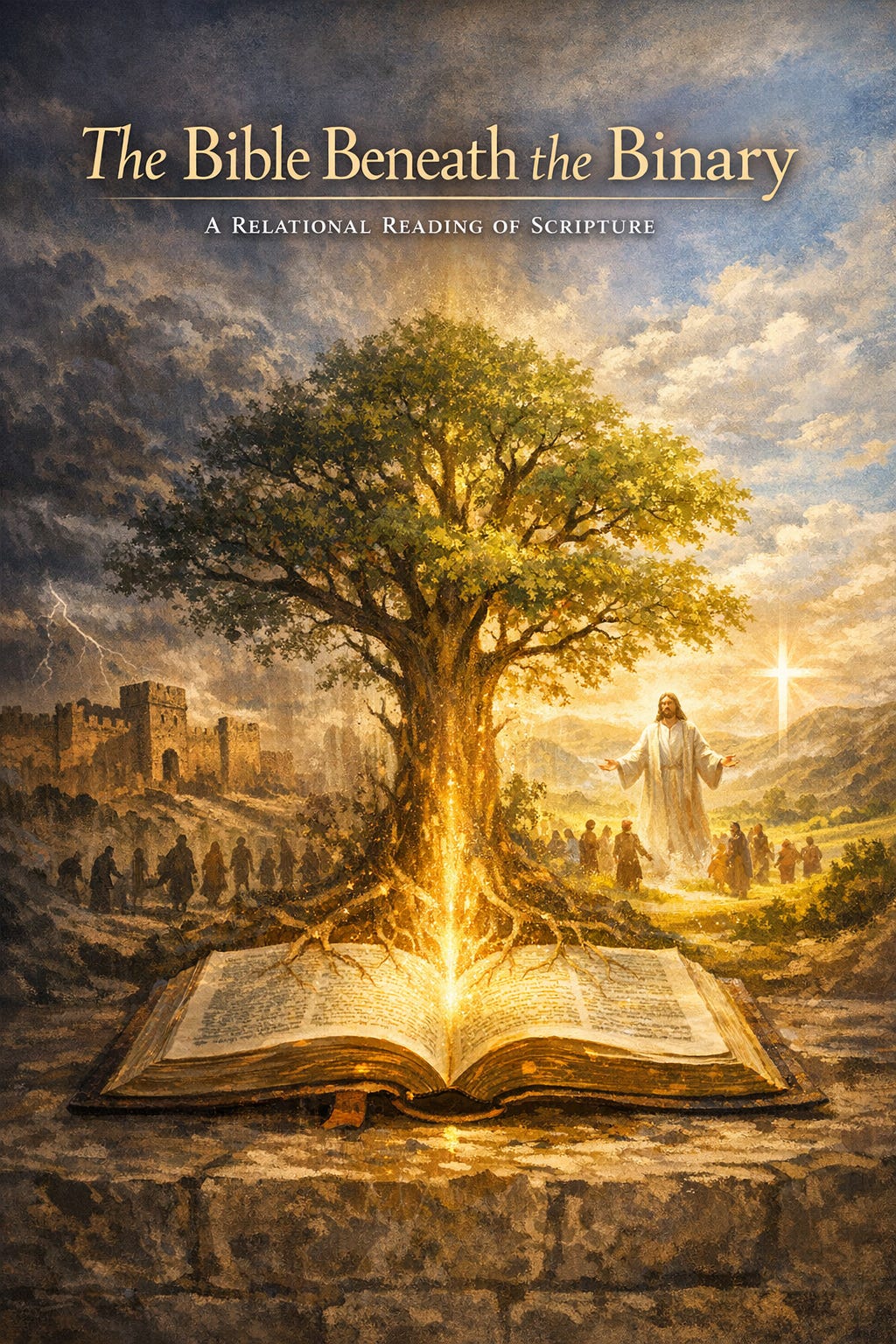
Most people are taught to read the Bible as a book about rules, beliefs, and moral categories.
Who is right.
Who is wrong.
Who obeyed.
Who rebelled.
Who belongs.
Who is saved.
Who is condemned.
That reading is understandable. The Bible certainly contains law, judgement, tribe, hierarchy, and conflict. It contains stories of war, failure, punishment, covenant, exile, and return. It has often been taught through the language of obedience and disobedience, righteousness and sin, heaven and hell, sheep and goats.
But beneath that surface layer, another current seems to run.
It is quieter, but deeper.
It is less concerned with rule-keeping than with right relation. Less concerned with moral theatre than with living contact. Less concerned with fixed identity than with the quality of connection between the part and the whole, the person and God, the self and reality, neighbour and neighbour, branch and vine, member and body.
Read this way, the Bible begins to look very different.
It begins to look like a long account of what happens when relation breaks down, when human beings fall into defended separation, and when life is slowly called back into contact with a deeper unity that law alone cannot restore.
This is not the only way to read scripture. But it may illuminate something many people have sensed for a long time: that the living heart of the Bible is often obscured by the systems built around it.
The signal may be relational.
The structure may be the compression.
The fall as separation into judgement
The opening chapters of Genesis are often treated as the beginning of moral failure.
Humanity disobeys. Humanity falls. Sin enters the world.
That is the traditional frame, and it has weight. But there may be something even deeper occurring in symbolic terms.
The tree in Eden is not merely the tree of knowledge. It is the tree of the knowledge of good and evil.
That detail matters.
Before this, there is directness. Presence. Unbroken relation. Humanity is not yet self-conscious in the way it later becomes. It is not yet divided against itself through shame, concealment, judgement, and defended knowing. Then comes the turn. The fruit is taken. The eyes are opened. Shame appears. Hiding begins. Blame begins. Distance begins.
What emerges immediately is not simply bad behaviour.
It is separation.
The human being becomes self-divided, relationally divided, and perceptually divided. Life is no longer encountered in immediate contact, but through the unstable lens of contrast, judgement, and self-protection. Adam and Eve do not simply break a rule. They begin living through a different mode of consciousness.
They hide.
They cover themselves.
They explain.
They accuse.
This looks remarkably like the birth of defended identity.
The story can therefore be read not only as legal transgression, but as a movement from awareness into compression. From direct participation into interpretive distance. From unselfconscious life into the management of self under perceived threat.
That is why exile follows. Not as arbitrary punishment alone, but as the natural consequence of separation from living contact.
The fall is not only about behaviour. It is about a rupture in relation.
Sin as disconnection
This changes the meaning of sin.
In many religious settings, sin is imagined primarily as wrongdoing. Breaking commands. Failing morally. Falling beneath a standard that must then be satisfied through guilt, punishment, sacrifice, or pardon.
But beneath that legal reading sits another possibility.
Sin may be understood more deeply as disconnection.
Not evil as an essence, but loss of alignment. Loss of attunement. Missing the living pattern. Falling out of right relation with reality, with others, with oneself, and with God.
This does not make moral behaviour irrelevant. On the contrary, behaviour matters greatly. But behaviour becomes the visible expression of something deeper. Cruelty, domination, dishonesty, pride, idolatry, betrayal, violence, and injustice are not merely infractions on a list. They are patterns of disconnection. They are what happens when the part turns in upon itself and loses contact with the whole.
This is why biblical sin so often has a relational texture.
Hearts harden.
People forget.
They worship idols.
They oppress the poor.
They trust appearances.
They seek status.
They refuse mercy.
They lose sight of what matters most.
The issue is not merely that they do bad things. It is that they have become unavailable to truth. Their conduct is distorted because relation has been distorted.
Seen this way, repentance is not simply remorse. It is reorientation. A turning back. A restoration of contact.
The kingdom as a mode of perception
This relational current becomes even clearer in the teachings of Jesus.
The language of the Kingdom of God has often been framed in political, apocalyptic, or institutional terms. People imagine a divine regime, a future order, a cosmic sorting. There are passages that support such readings.
Yet the way Jesus speaks of the kingdom often feels more immediate and interior than that.
The kingdom is near.
The kingdom is within you, or among you.
Those with ears to hear can perceive it.
Children enter it more easily than the self-important.
The poor in spirit are close to it.
This does not sound merely like a future government. It sounds like an available order of being. A different mode of participation in reality. A way of seeing and living that becomes possible when the usual structures of pride, fear, status, and defended certainty loosen their grip.
People expecting spectacle miss it.
People certain of their own righteousness miss it.
People invested in control often oppose it.
Why?
Because the kingdom, in this reading, is not the triumph of one tribe over another. It is the restoration of right relation. It is a field condition of deeper coherence. It is available not through self-assertion, but through openness, humility, receptivity, and trust.
This is why Jesus so often seems to unsettle the religiously certain while drawing near to those who have less status to defend.
He is not simply announcing a doctrine. He is revealing a way of seeing.
The vine and the branches
Few biblical images are more clearly relational than the vine and the branches.
A branch cannot live in isolation. It does not generate life from itself. It remains alive by staying connected to the vine. Its fruitfulness is not a private achievement. It is a function of living participation in a larger source.
This is not merely a metaphor for obedience.
It is a metaphor of conductance.
Abide in me, Jesus says, and the life continues to flow. Sever the branch from the vine, and it withers. The point is not moral intimidation. The point is ontological and relational. Life itself is participatory. To remain cut off from the source is to lose access to the deeper order that allows right action, right perception, and right fruit to emerge.
This pattern appears again and again in scripture.
Life comes through relation.
Strength comes through surrender.
Fruit comes through abiding.
Wisdom comes through listening.
Peace comes through alignment rather than domination.
The biblical imagination, at its deepest, seems far less interested in autonomous selfhood than modern people often are. Again and again, the human being is shown as derivative in the healthiest sense, not self-originating, but capable of great coherence when properly connected.
Many members, one body
The image of the body carries the same logic.
The body is not a collection of independent units. It is a coordinated whole. Each member is distinct, but no member is self-sufficient. The eye cannot say to the hand, I have no need of you. The suffering of one affects all. The honour of one affects all.
This is not merely a lesson in teamwork. It is a vision of reality.
The body metaphor assumes that life emerges through relation. Meaning does not sit inside isolated parts. It arises through their belonging to a wider order. Distinction is preserved, but separation is not treated as wisdom.
This has profound implications.
It means the self is not erased, but situated. It means value does not come from superiority, but from right participation. It means that fragmentation, envy, domination, and self-importance are not simply bad attitudes. They are failures to recognise the nature of the whole.
This is one reason the biblical tradition can be so critical of pride. Pride is not only arrogance. It is the illusion of self-sufficiency. The part pretending to be the whole.
That pattern should sound familiar across every scale of life. Cells, organisations, relationships, nations, egos. The same distortion recurs when a local node forgets the larger pattern and begins to organise around its own defended continuity.
The letter and the spirit
One of the sharpest distinctions in the New Testament is between letter and spirit.
The letter kills. The spirit gives life.
This line is often quoted, but perhaps not fully absorbed.
At one level, it is a statement about legalism. Rules alone cannot save. The form without the living reality becomes deadening. Yet there is something still deeper in it.
The letter is fixed formulation.
The spirit is living relation.
The letter attempts to preserve truth in codified form. That has value. Form matters. Law matters. Boundaries matter. But when the form becomes primary, something happens. The living signal gets compressed into external compliance. Identity reorganises around appearing correct. Religion becomes performance before it remains participation.
This is why Jesus so often collides with religious legalism.
Not because structure is inherently wrong, but because structure without living contact becomes distortion. People begin to honour the form while losing the reality it was supposed to protect. They tithe herbs and neglect mercy. They keep rules and miss love. They preserve Sabbath law while losing the human being standing in front of them.
In this sense, the letter is not evil. It is incomplete. It becomes dangerous when it replaces the living field from which it was derived.
The spirit is not anti-order. It is deeper order.
Love as the fulfilment of law
This is why love sits at the centre.
Not as sentiment. Not as mere niceness. But as the deepest organising principle of the whole.
Again and again, scripture points beyond compliance toward love. The greatest commandments are relational. Love God. Love your neighbour. Love one another. The whole law is fulfilled here. Without love, even religious brilliance becomes noise. Prophecy, sacrifice, knowledge, power, gifts, certainty, even faith itself can become hollow when severed from love.
That is a radical claim.
It suggests that love is not one virtue among many. It is the condition under which everything else becomes properly ordered. Love is what keeps truth from becoming cruelty. Justice from becoming vengeance. Strength from becoming domination. Difference from becoming division. Devotion from becoming performance.
Love, in this reading, is not soft. It is structurally primary.
It is what restores coherence between self and other, part and whole, form and life. It is what allows truth to travel without immediate distortion. It is what keeps relationship from collapsing into transaction, role, or power.
This may be one reason why love is so difficult to sustain. Love threatens every identity structure built on superiority, fear, control, or defended self-importance. Love asks the self to remain open where identity would rather harden. It asks for contact where shame would rather hide. It asks for mercy where hurt would rather prosecute.
Love is not difficult because it is decorative. It is difficult because it reorganises reality.
Grace as release from the burden of self-maintenance
Grace also looks different through this lens.
In many Christian settings, grace is taught primarily as undeserved pardon. That is true as far as it goes. But grace may also be understood more relationally as release from the entire economy of defended worth.
The person no longer has to build a self through moral bookkeeping. No longer has to earn love through perfect performance. No longer has to sustain identity through constant self-justification. Grace interrupts the exhausting attempt to secure life through the mask.
This matters because religion can sometimes intensify the very burden it claims to relieve.
People become obsessed with being good enough, pure enough, right enough, safe enough, saved enough. They monitor themselves endlessly. They live in moral compression. They fear both failure and exposure.
Grace cuts across that.
Grace says life cannot be held together through self-constructed worth. Grace lowers the heat. Grace restores the possibility of relation where identity has become trapped in debt, shame, and defended striving.
In that sense, grace is not merely a legal declaration. It is the restoration of flow.
The person can stop hiding.
Stop performing innocence.
Stop bargaining for belonging.
Stop organising around condemnation.
This is why grace often feels scandalous to moral systems. It cannot be controlled by merit. It reaches beneath the ledger.
Forgiveness as the ending of relational debt
The same can be said of forgiveness.
Forgiveness is often misunderstood as pretending harm did not happen. Or as weak submission. Or as immediate reconciliation regardless of truth. But the biblical logic is deeper than that.
Forgiveness ends the endless recycling of debt.
It refuses to keep identity locked around accusation forever. It interrupts the heat of perpetual moral accounting. It does not necessarily remove consequence, restore trust instantly, or erase boundaries. But it does stop the self from becoming organised entirely around injury and repayment.
This is one reason forgiveness is so hard. Hurt seeks justice, recognition, and safety. Sometimes those are indeed needed. But the human ego also finds a strange stability in unpaid debts. To remain the wronged one can become a moral shelter. Forgiveness threatens that shelter. It asks whether the wound must remain the organising centre of selfhood.
That does not mean abuse should be minimised or boundaries dissolved. It means forgiveness is best understood not as sentimental softness, but as the release of relational poison.
It is one of the ways the field cools.
Christ as the interruption of defended identity
Seen through this lens, Christ appears not merely as a doctrinal figure to be believed in, but as a living pattern that interrupts identity-based reality.
He repeatedly destabilises the structures through which human beings secure themselves.
The righteous are challenged.
The excluded are welcomed.
The powerful are exposed.
The sinner is met without reduction.
The rule is placed beneath the human need it was meant to serve.
The outsider is made central.
The certain are made uncertain.
This is not moral chaos. It is a deeper order than legal performance can hold.
Jesus seems to move from a place not dominated by self-defence. He does not appear governed by image management, tribal loyalty, prestige protection, or institutional fear. That is one reason he is so threatening. A non-defended human being reveals the poverty of systems built on defended identity.
He sees through masks.
He refuses easy binaries.
He returns again and again to the heart, the root, the hidden pattern beneath the visible act.
This is why some people experience the Gospels as liberating even when they have found religion oppressive. They recognise a difference between the living signal and the institutional compression of that signal.
Religion as compression layer
This does not mean religion is worthless.
Forms are necessary. Communities need structure. Traditions preserve memory. Language matters. Ritual can help hold the sacred. Doctrine can guard against confusion. None of this should be dismissed carelessly.
But every living signal is vulnerable to compression.
What begins as relation can become rule.
What begins as encounter can become institution.
What begins as spirit can become formula.
What begins as love can become belonging-through-compliance.
This is not unique to Christianity. It is a recurring human pattern.
We receive something alive, then build identities around it. We preserve the shell and lose the pulse. We defend the structure because it once carried truth, even after it has started obstructing the truth it was formed to protect.
The Bible itself seems aware of this danger. It repeatedly critiques idolatry, hardened hearts, empty ritual, external righteousness, and those who honour God with their lips while being far away in living reality.
In that sense, scripture contains within itself a warning about religion’s own failure modes.
The Bible beneath the binary
None of this erases the harder parts of the Bible. Scripture still contains violence, exclusivity, judgement, and passages that have been used to justify domination. A relational reading does not dissolve those tensions. It simply refuses to let them become the whole story.
Beneath the binary, another pattern persists.
Separation and return.
Hardness and softening.
Exile and restoration.
Law and spirit.
Pride and surrender.
Fear and love.
Isolation and body.
Branch and vine.
Letter and life.
Read from this level, the Bible becomes less like a manual of moral tribalism and more like a long struggle to recover living relation after humanity has become trapped in judgement, shame, and defended selfhood.
The deepest problem is not merely bad behaviour.
It is disconnection.
The deepest solution is not mere compliance.
It is restored contact.
That restored contact has many names in scripture.
Abiding.
Faith.
Love.
Grace.
Mercy.
Communion.
The kingdom.
The spirit.
Life.
Perhaps the question is not only whether the Bible is true in a doctrinal sense.
Perhaps the deeper question is whether we can still hear the relational signal beneath the layers of fear, certainty, identity, and control that history has wrapped around it.
Because if that signal is still there, then scripture may be pointing toward something far older and more intimate than religion alone.
Not a demand to become correct.
But an invitation to become reconnected.
And that may be the difference between a faith that imprisons the self and a truth that sets it back into living relation.